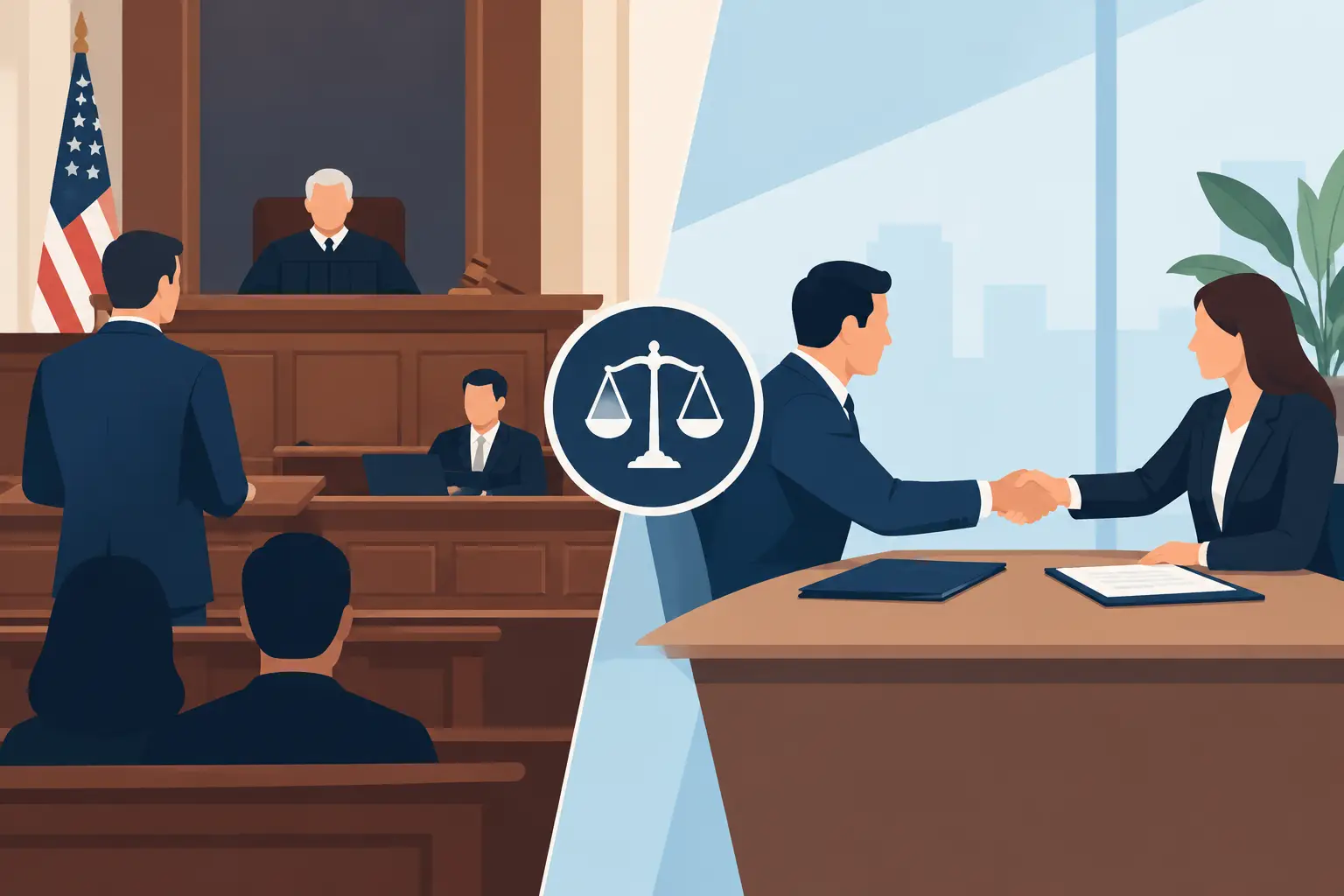
A prosecutor puts an offer on the table. It may mean less prison time, probation, a reduced charge, or a chance to avoid a trial that could put your entire life under a microscope. That does not automatically make it a good deal. In a felony trial vs negotiated resolution decision, the real question is not which path feels safer. It is which path protects your freedom, record, family, career, and future based on the actual evidence.
A felony case is not the time for guesswork or pressure-driven decisions. The State has resources, police reports, witnesses, and a theory of guilt. You need a defense strategy built around the weak points in that case, not just the fear of the possible sentence.
This Is Not a Test of Courage
Some people believe taking a case to trial proves they are fighting. Others believe accepting a negotiated resolution proves they are being practical. Both ideas can get someone hurt.
A trial may be the right move when the evidence is thin, police violated constitutional rights, a key witness cannot be trusted, or the State cannot prove every element of the charge beyond a reasonable doubt. A negotiated resolution may be the stronger move when the evidence is overwhelming and a carefully structured agreement avoids a far worse outcome.
The point is simple: do not plead because you are scared, and do not try a case because you are angry. Make the decision from a position of knowledge and strength.
What a Felony Trial Can Offer
At trial, the State must prove its case beyond a reasonable doubt. You do not have to prove your innocence. The defense can challenge how police obtained evidence, expose contradictions in witness statements, attack unreliable forensic claims, and force the prosecution to meet its burden in open court.
That burden matters. A charge is an accusation, not a conviction. Police can make bad assumptions. Witnesses can be mistaken or motivated by self-interest. Video can be incomplete. A confession can be disputed. Evidence can be illegally obtained or handled carelessly.
When Trial Leverage Is Real
A case may be trial-ready when the State has a serious proof problem. That could include a questionable search, an unlawful stop, an uncooperative witness, missing evidence, conflicting accounts, or an alleged victim whose testimony does not match the physical evidence.
In major felony cases, the prosecution may also rely on broad narratives. RICO allegations, conspiracy charges, gun cases, and drug prosecutions often involve large volumes of material. More evidence does not always mean better evidence. It can mean more gaps to identify, more assumptions to challenge, and more opportunities for the State to overreach.
A credible trial defense also creates negotiating power. Prosecutors evaluate risk. If they know the defense has done the work, found the flaws, and is prepared to put the case in front of a jury, their view of a fair resolution can change.
The Hard Truth About Trial Risk
Trial is not a magic reset button. If a jury convicts, the sentence may be substantially harsher than an offer that was available before trial. Felony trials can also be emotionally draining, public, and unpredictable. Even a strong defense does not remove all risk.
There are decisions that cannot be made from a police report alone. A lawyer needs to examine the discovery, investigate facts outside the State’s file, assess the judge, understand the local courtroom, and prepare for the evidence that will actually reach a jury.
What a Negotiated Resolution Really Means
A negotiated resolution is often called a plea deal, but it can take different forms. It may involve a reduced charge, an agreement on sentencing, probation, treatment, or a plea to one count in exchange for dismissal of others. In some Georgia cases, options such as First Offender treatment or a conditional discharge may be worth evaluating, depending on the charge and the person’s eligibility.
These options are not automatic gifts. They carry conditions, restrictions, and consequences that must be understood before anyone signs paperwork or enters a plea in court.
A negotiated result can be a smart, strategic choice. It can limit exposure, create certainty, protect someone from the risk of a long prison sentence, or resolve a case in a way that lets a person keep working and caring for family. But an agreement is only as good as its terms.
Read the Fine Print of Any Deal
Before accepting a resolution, ask what happens to the exact charge, not just the immediate sentence. A felony conviction can affect employment, professional licenses, housing, firearm rights, immigration status, voting rights, custody disputes, and future criminal cases.
Probation is not freedom without rules. It can involve reporting, testing, treatment, fees, travel restrictions, curfews, community service, and strict compliance requirements. A probation violation can put the original case back in front of a judge under far worse circumstances.
First Offender treatment can be valuable for an eligible person who successfully completes the sentence, but it is not a casual decision and it is not available in every case. The exact consequences depend on the offense, the terms imposed, and the person’s history. A lawyer should explain the real-world effect, not sell it as a slogan.
Felony Trial vs Negotiated Resolution: What Drives the Choice?
The best decision comes from a clear assessment of risk, leverage, and goals. No two felony cases are alike, even when the charges look similar on paper.
Four questions should drive the conversation:
- How strong is the State’s admissible evidence, not merely its allegations?
- What evidence can be suppressed, excluded, contradicted, or explained?
- What is the realistic sentencing exposure after a conviction compared with the proposed deal?
- What consequences will follow you after court, including work, family, licensing, immigration, and firearm issues?
Your personal priorities matter too. One client may be willing to accept significant trial risk rather than admit to something they did not do. Another may need a resolution that minimizes time away from children, work, or medical care. A serious defense lawyer does not make that choice for the client. The lawyer gives the client the straight truth needed to make it wisely.
Do Not Let the State Set the Clock
Prosecutors sometimes present an offer as a now-or-never opportunity. Sometimes there is a legitimate deadline. Sometimes the pressure is part of the negotiation. Either way, a rushed plea is dangerous when the defense has not completed its investigation or reviewed the evidence.
That does not mean every offer should be rejected. It means every offer should be tested. Is the State offering a reduction because the evidence is weak? Is there surveillance video nobody has reviewed? Was the search legal? Did a witness change their story? Is the proposed sentence actually better than the likely result after motions and negotiations?
The strongest defense posture is often to prepare for trial while remaining open to a resolution that genuinely serves the client. Trial preparation is not theater. It is how the defense finds the facts that change the case.
Get Advice Built for Your Case, Not Someone Else’s
A friend who took probation for a felony charge cannot tell you what to do with yours. An online sentencing chart cannot account for your evidence, your judge, your history, your family, or the prosecutor handling the case. High-stakes cases demand individual analysis.
At Weinstein Criminal Defense, the approach is direct: examine the case hard, identify the pressure points, prepare to fight, and tell clients the truth even when it is not what they hoped to hear. That is how meaningful decisions get made.
The next move should not be driven by panic or false confidence. Get the evidence evaluated early, understand every consequence on the table, and choose the path you can live with after the courtroom door closes.
Leave a Reply