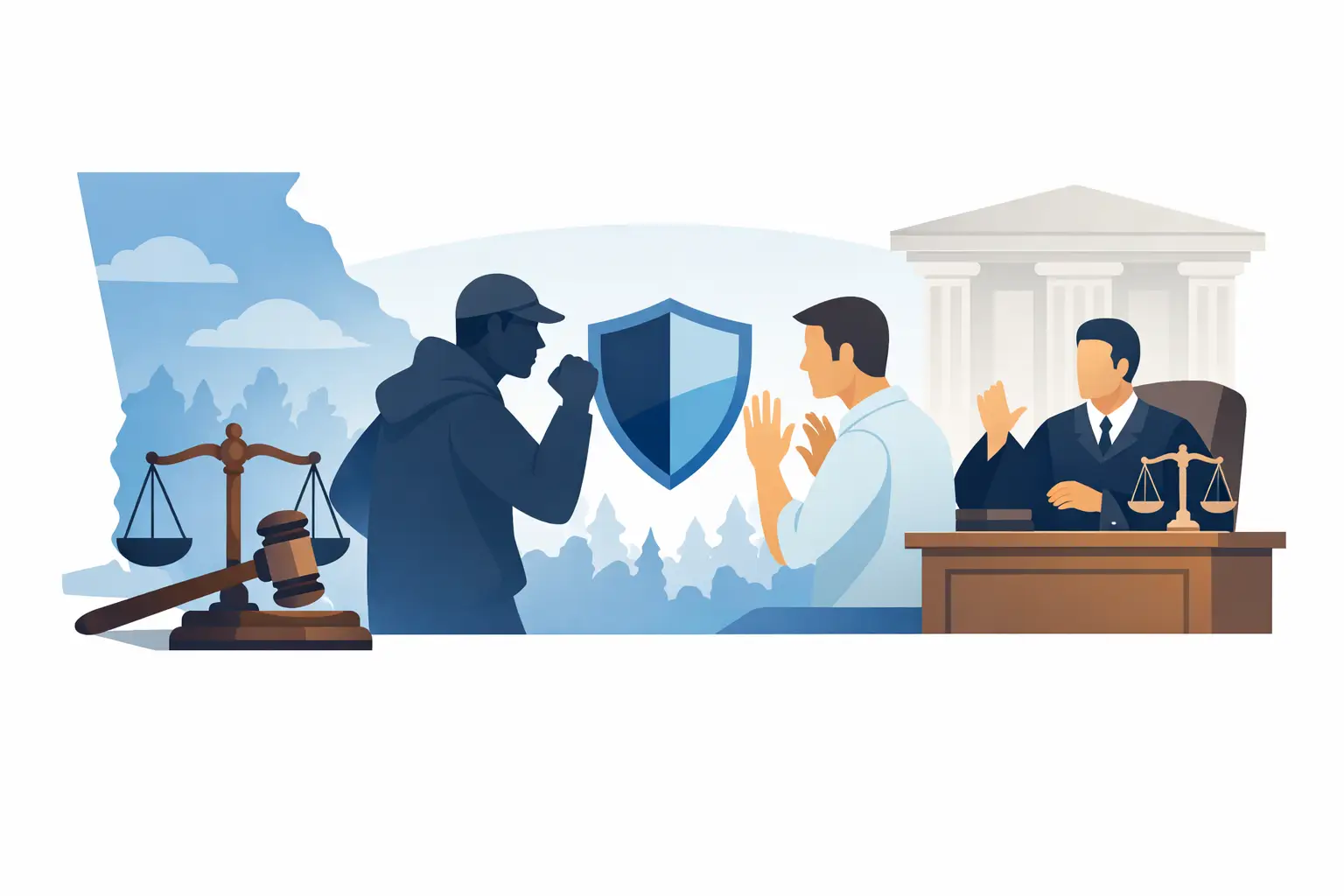
A self-defense case can turn on seconds of violence, but the fight over what those seconds meant may last for months. The question of how to defend a self-defense claim in Georgia is not answered by simply saying, “I was scared” or “he started it.” The defense has to be built from facts, evidence, timing, and a clear understanding of Georgia law.
Police may arrive after the threat is over. They may see an injured person, a weapon, a chaotic scene, and competing stories. Prosecutors then decide whether they can frame you as the aggressor. If your freedom is on the line, you need a defense that does more than repeat your version of events. You need one that proves why your actions were legally justified.
What Georgia Self-Defense Law Actually Requires
Georgia law allows a person to use force when they reasonably believe it is necessary to defend themselves or another person against the imminent use of unlawful force. The force used must fit the threat. That is the hard part in many cases.
Deadly force is subject to a higher standard. Generally, it may be justified only when you reasonably believe it is necessary to prevent death, great bodily injury, or the commission of a forcible felony. A verbal argument, an insult, or even a shove does not automatically justify a gun, knife, or other deadly weapon.
The word “reasonable” matters. The law does not require you to wait until you are actually beaten, stabbed, or shot. But a jury will examine what you knew at that moment: the other person’s actions, size, threats, weapons, prior violence, location, ability to escape, and the speed at which events unfolded.
Georgia generally does not impose a duty to retreat before using force if you are legally present and not engaged in unlawful activity. That does not mean retreat is irrelevant. If video shows you had time and room to walk away, a prosecutor may use it to argue that you were not facing an immediate threat or that your force was unnecessary. The facts still control.
How to Defend a Self-Defense Claim From Day One
A successful defense starts early because evidence disappears fast. Security footage is overwritten. Witnesses talk to each other. Text messages get deleted. Bruises fade. The prosecution is already building its theory while many accused people are still trying to process what happened.
The first job is to preserve the full story, not the version that looks worst in a single photograph or a 20-second video clip. That can include 911 calls, body-camera footage, nearby surveillance footage, photographs of injuries, weapons analysis, dispatch records, phone data, messages, social-media posts, and testimony from witnesses who saw the confrontation begin.
Context can be decisive. A video that starts when you strike back may look terrible if it omits the threat, chase, assault, or attempted forced entry that came first. Likewise, a person who appears unarmed may still have made a credible threat based on prior conduct, physical disparity, a group attack, or an attempt to take your weapon.
Your lawyer should also examine the State’s evidence for gaps. Was every witness interviewed? Did officers document your injuries? Were statements taken after a witness had heard other accounts? Was a weapon tested? Did police assume the person who called 911 was the victim? An arrest is not proof. Police make quick decisions under pressure, and those decisions can be incomplete or wrong.
Your Statements Can Help or Hurt
After a violent encounter, people often talk too much. They want to explain. They want the police to understand. They may apologize for someone being hurt, speculate about what happened, or use careless language that later sounds like an admission.
You have the right to remain silent and the right to ask for a lawyer. Use them. That is not an admission of guilt. It is common sense when every sentence may be dissected by detectives, prosecutors, and a jury.
Do not coordinate stories with witnesses, delete messages, post about the incident, or contact the alleged victim to “clear things up.” Those choices can create separate legal problems and give the State ammunition it did not have before. Preserve what you have, follow counsel’s instructions, and let your defense team handle communication.
The Prosecutor Will Look for an Aggressor
Self-defense is not a free pass for someone who provoked the conflict, started the fight, or continued using force after the threat ended. The State will often focus on who escalated the encounter and whether you had a lawful reason to fear imminent harm.
That means the defense must confront bad facts directly. If there was an argument beforehand, the jury needs to understand what was said and done. If you armed yourself, the defense must explain why that fact does or does not show intent to start violence. If the other person was injured more severely, the defense must show why the force was necessary at the time, rather than allowing the case to become a simple comparison of injuries.
Georgia law also places limits on self-defense when a person is committing a felony, is the initial aggressor, or uses force after voluntarily entering a mutual combat arrangement. Those issues are fact-specific. An alleged aggressor may regain the right to self-defense in limited circumstances, such as when they clearly withdraw and communicate that withdrawal but the other person continues the attack. This is not an area for guesswork.
Pretrial Immunity May Be an Option
In some Georgia cases, a person who acted in lawful self-defense can seek immunity from prosecution before trial. This is different from simply presenting self-defense to a jury. At an immunity hearing, the defense asks the judge to find that the use of force was justified and that the prosecution should not continue.
There is a trade-off. An immunity hearing can offer an opportunity to end the case early, but it also gives the prosecution a preview of evidence and testimony. The defense must weigh the strength of the available proof, the credibility of witnesses, whether additional investigation is needed, and the risks of putting the accused on the record before trial.
The burden at an immunity hearing differs from the burden at trial. At trial, once self-defense is properly raised, the State must prove beyond a reasonable doubt that the defendant did not act in justified self-defense. At an immunity hearing, the defendant generally carries the burden of establishing justification by a preponderance of the evidence. That distinction matters when deciding strategy.
Build the Case Around What a Jury Can See
Jurors do not experience the confrontation from your point of view. They receive pieces of it in a courtroom: photos, transcripts, videos, diagrams, expert testimony, and witness memories. A strong defense organizes those pieces into a truthful, understandable account of the danger you faced.
Sometimes that requires a use-of-force expert, a medical expert, a digital-forensics review, or a reconstruction of sight lines and timing. Sometimes the most persuasive evidence is far simpler: a 911 recording, a doorbell camera, injuries officers failed to photograph, or a witness who has no reason to take sides.
Credibility is central. A defense lawyer should not promise that every fact looks good. Serious cases rarely work that way. The job is to identify the facts that matter legally, challenge unsupported assumptions, and make sure the jury hears the entire story before it decides whether a crime occurred.
Get Serious Counsel Before the Story Hardens
If you have been arrested, contacted by police, or believe an investigation is coming, treat the situation as urgent. Do not wait for charges to become more serious before getting legal advice. Early defense work can preserve evidence, prevent avoidable mistakes, and shape the record before a one-sided narrative takes hold.
A self-defense claim is not won by being the loudest person in the room. It is won by careful facts, disciplined strategy, and a lawyer prepared to fight when the State tries to turn survival into a crime. The hours after an incident matter. Protect your rights before someone else decides what your story means.
Leave a Reply