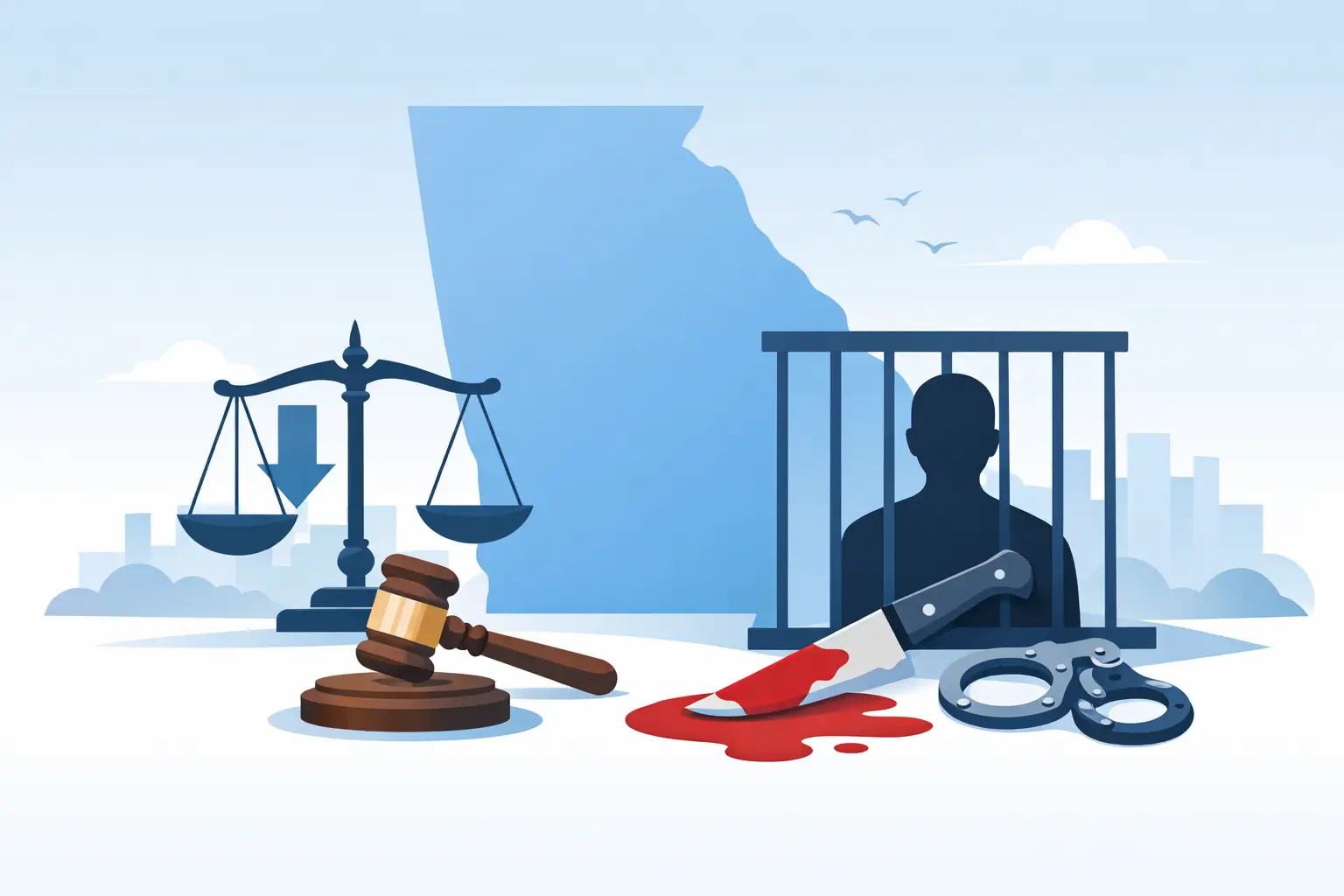
A murder arrest drops like a bomb. One minute your life is moving, the next you are staring at the kind of charge that can put you in prison for decades or for life. So yes, people ask fast and often: can murder charges be reduced?
Sometimes, yes. But not because someone asks nicely, and not because the case feels unfair. Murder charges get reduced when the facts, the law, and the defense strategy put real pressure on the prosecution’s theory. That is where the fight starts.
Can murder charges be reduced?
In Georgia, a murder charge can sometimes be reduced to a lesser offense such as voluntary manslaughter, involuntary manslaughter, aggravated assault, or another homicide-related count. It depends on what the evidence actually shows, what the state can prove beyond a reasonable doubt, and whether there are legal problems in the case.
That said, not every murder case is built the same. Some are overcharged from the start. Some involve self-defense. Some involve heat-of-passion facts. Some rest on shaky witnesses, bad forensic assumptions, or statements taken in violation of constitutional rights. And some are exactly as serious as the state claims. Straight truth matters here. A strong defense starts with seeing the case clearly, not pretending every charge magically disappears.
Why murder charges get reduced
Prosecutors file the highest charge they believe the facts will support. Later, that charge may change if the evidence does not hold up under pressure. That pressure can come from a detailed case investigation, pretrial motions, witness impeachment, forensic review, or trial risk.
A reduction often happens because the state has a proof problem. Maybe intent is weak. Maybe causation is not as clean as the charging document suggests. Maybe there is evidence of provocation, mutual combat, self-defense, or defense of others. Maybe a key witness is changing stories. Maybe the accused was present but not the killer. In a serious violent felony, those distinctions are everything.
The state also has to think practically. Prosecutors do not just look at the police narrative. They look at what they can persuade twelve jurors to believe. If the defense exposes enough weakness, a reduced charge may become the safer option for the state.
The charges a murder case may be reduced to
Not every reduction is a win, and not every lesser charge carries light consequences. But in the right case, a reduction can dramatically change sentencing exposure and trial posture.
Voluntary manslaughter
This is one of the most discussed reductions in a murder case. In Georgia, voluntary manslaughter may apply when a person causes a death under a sudden, violent, and irresistible passion resulting from serious provocation. That does not excuse a killing. It can, however, reduce what would otherwise be treated as murder.
This issue comes up in cases involving fights, domestic confrontations, shocking discoveries, or rapidly escalating violence. The timing matters. The facts matter. Whether there was a cooling-off period matters.
Involuntary manslaughter
Involuntary manslaughter may come into play when the death happened without the intent required for murder, often during the commission of a lesser unlawful act or during a lawful act done in an unlawful way. These cases can get technical quickly.
A death caused by reckless or unlawful behavior is still serious. But if the evidence does not prove malice or the required mental state for murder, that gap matters.
Aggravated assault or other non-homicide offenses
In some cases, the defense position is not that the death did not happen, but that legal responsibility for murder cannot be proven. Questions about causation, intervening acts, medical complications, identity, or intent can shift the focus to a non-homicide charge.
That is not common in every case, but it happens. When the facts are messy, the charging decision may move with them.
What facts matter most
People often think the whole case turns on one dramatic fact. Usually it does not. Murder cases are built from many moving parts, and the weak point is not always where police say it is.
Intent and malice
If the prosecution cannot prove the required mental state, that opens the door to a lesser charge. Words, prior threats, weapon use, location of injuries, and conduct before and after the incident all get picked apart here.
Self-defense or defense of others
If there is credible evidence that force was used lawfully, the case may not just be reduced. It may be defensible outright. But self-defense claims are fact-heavy, and prosecutors attack them aggressively. Who started the conflict, whether the force was proportional, and what each witness saw can make or break the case.
Provocation and heat of passion
These facts can shift a murder theory toward voluntary manslaughter. But not every angry reaction qualifies. The law does not reward revenge. It looks at whether the provocation was serious enough and whether events happened in a way that supports a legally recognized reduction.
Causation
The state must prove the defendant legally caused the death. That sounds obvious until you get into real cases involving multiple actors, delayed death, preexisting injuries, medical intervention, or uncertain forensic conclusions.
Witness credibility
A murder case can rise or fall on witness testimony. If witnesses were intoxicated, biased, scared, coached, inconsistent, or trying to protect themselves, the prosecution’s version of events may start to crack.
Can murder charges be reduced before trial?
Yes. In fact, many serious charges are fought hardest before a jury is ever picked. Pretrial work is where a strong defense can expose illegal searches, challenge statements, test forensic methods, uncover favorable evidence, and pin witnesses down before their stories harden.
If key evidence gets suppressed, the state’s leverage can drop fast. If the defense investigation turns up facts police ignored, the original charge may no longer fit. Reduction discussions often happen quietly, after the prosecution realizes the case is not as clean as the indictment makes it sound.
But there is a trade-off. Sometimes a prosecutor offers a reduced charge to avoid trial risk, and sometimes that offer still carries massive penalties. The right answer depends on the strength of the defense, the client’s goals, sentencing exposure, and the danger of a trial loss. This is where blunt legal advice matters most.
What a defense lawyer actually does to push for a reduction
A real defense is not just arguing that the client is a good person. In a murder case, that gets nowhere. The work is harder and far more specific.
A serious defense lawyer rebuilds the timeline, interviews witnesses independently, studies the medical and forensic evidence, examines digital records, challenges identification, and tests every statement the state plans to use. The lawyer also looks for overcharging, inconsistent theories, and constitutional violations.
That work can create three outcomes. It can support a full defense at trial, it can force the state to offer a reduced charge, or it can position the case for dismissal of certain counts. Sometimes all three possibilities are in play at once.
This is also why early representation matters. The sooner the defense gets involved, the better the chance of preserving evidence, controlling damaging mistakes, and shaping the case before the state’s narrative hardens.
What families and defendants should not assume
Do not assume the initial charge is final. Do not assume a reduction is guaranteed either. And do not assume talking your way out of a murder investigation without counsel is smart. It is not.
People under pressure often make the case worse by giving statements, guessing at facts, deleting messages, contacting witnesses, or trusting that the truth will sort itself out. The system does not work that way. You need facts, strategy, and someone ready to fight.
If you are facing this in Georgia, the question is not just can murder charges be reduced. The real question is what the state can actually prove once the defense starts punching holes in the case. That answer takes work, experience, and the willingness to tell you the truth even when it is hard.
At Weinstein Criminal Defense, that is the job: protect your rights, test every fact, and fight the case like the outcome matters, because it does.
If you or someone you love is charged with murder, move fast, stay quiet, and get a defense lawyer who is built for high-stakes cases. A strong case strategy can change the ground under your feet.
Leave a Reply