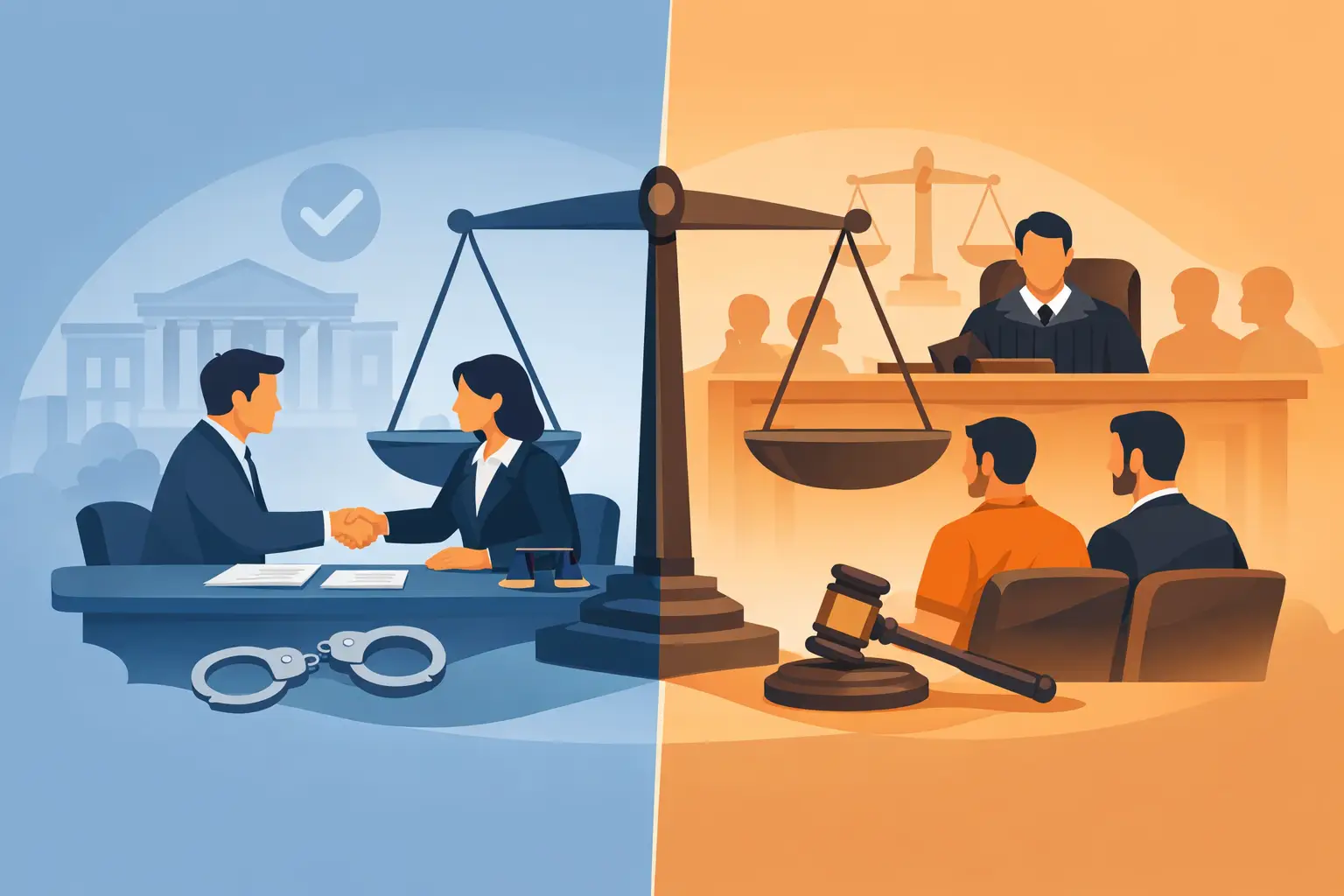
The pressure usually hits fast. The State puts an offer on the table, your family wants answers, and suddenly the question becomes plea bargain vs trial. That choice can affect your freedom, your record, your job, and what happens to your life long after the court date is over.
This is not a decision to make out of fear, pride, or panic. It has to be made with clear eyes. Some plea deals are smart. Some are traps. Some cases should settle. Some cases need to be tried hard in front of a jury.
Plea bargain vs trial is really a question of risk
People often ask which option is better as if there is a universal answer. There is not. The right move depends on the facts, the charge, the evidence, the judge, the prosecutor, your record, and what is truly at stake.
A plea bargain is an agreement. In most criminal cases, the defendant agrees to plead guilty, or sometimes no contest, in exchange for something from the prosecution. That could mean a reduced charge, a lighter sentence recommendation, dismissal of other counts, or some other negotiated outcome.
A trial is exactly what it sounds like. The State has to prove the case beyond a reasonable doubt. Witnesses testify. Evidence gets challenged. Your lawyer fights the prosecution point by point. If the jury does not buy what the State is selling, the verdict can be not guilty.
The trade-off is simple, even if the decision is not. A plea bargain usually gives more predictability. A trial gives you the chance to win outright, but it also carries real risk if the verdict goes the other way.
When a plea bargain makes sense
A good plea bargain can limit damage. If the evidence is strong, if key motions were denied, or if the sentencing exposure at trial is severe, a negotiated resolution may be the smartest move.
That is especially true when the offer meaningfully changes the outcome. Maybe a felony gets reduced. Maybe mandatory jail time is avoided. Maybe other charges disappear. Maybe probation is on the table instead of prison. In that situation, taking a deal is not weakness. It is strategy.
Plea deals can also matter when a person has priorities outside the courtroom. Some clients need to protect professional licenses. Some need to reduce immigration consequences. Some need to avoid the publicity and strain of a public trial. Some simply want certainty so they can start rebuilding.
But a plea bargain only makes sense if you understand what you are giving up. A guilty plea usually means giving up the right to trial, the right to confront witnesses, and in many cases the right to challenge certain issues later. It can also leave you with a permanent criminal record and collateral consequences that reach far beyond sentencing.
That is why the first offer is not always the best offer, and fast is not always smart.
When trial is the right fight
Some cases should not be pled. If the prosecution’s evidence is weak, inconsistent, illegally obtained, or built on witnesses who cannot hold up under cross-examination, trial may be the right move.
This matters in serious felony cases, but it matters in so-called smaller cases too. Prosecutors charge aggressively. Police reports are not the final word. Witnesses change stories. Searches get challenged. Identifications can be wrong. Video does not always show what the State claims it shows.
Sometimes the issue is not whether a deal exists. It is whether the deal is worth taking. If the plea offer still leaves you branded with a conviction that can wreck employment, housing, gun rights, custody issues, or your reputation, then the risk of trial may be justified.
Trial is also where a real defense lawyer earns it. Not every attorney is built for a courtroom. Some lawyers prepare every case as leverage for settlement. Others prepare every case like it may be tried in front of twelve people. That difference matters because prosecutors know who is serious and who is not.
The evidence should drive the decision
The most dangerous way to choose between a plea and trial is emotion. Fear pushes people to plead too early. Ego pushes people to reject deals they should consider. Neither one helps.
What helps is a hard look at the evidence.
If the State has credible witnesses, strong physical evidence, admissions, clean police work, and no obvious constitutional issues, the defense has to weigh that honestly. If the State’s case has holes, credibility problems, missing evidence, or legal weaknesses, that changes the leverage.
A smart lawyer does not just ask whether the prosecutor can say the client is guilty. The real question is whether the prosecutor can prove it beyond a reasonable doubt to a jury. Those are not the same thing.
This is where honesty matters. A lawyer who tells you only what you want to hear is not protecting you. Straight truth is better than fake comfort, especially when your future is on the line.
Plea bargain vs trial in Georgia courts
In Georgia, criminal cases move through a system that can feel rushed from the outside and painfully slow from the inside. Offers may come early, before all discovery is fully reviewed or investigated. That does not mean you should jump.
A plea entered too soon can shut down defenses before they are properly developed. Maybe the body camera footage was incomplete. Maybe the search was unlawful. Maybe a witness has a motive to lie. Maybe co-defendant issues change the landscape. You do not know what leverage you have until the case is worked up.
On the other hand, waiting for trial without a real strategic reason can also backfire. Offers can get worse. Sentencing exposure can become more serious if additional facts come out. Witnesses may tighten up. Judges may have little patience for gamesmanship. Timing matters.
That is why plea negotiations are not separate from trial preparation. The best plea positions often come from being ready to try the case.
Costs, stress, and consequences are real
People sometimes talk about trial as if it is just a brave choice. It is more than that. Trial is stressful, public, and demanding. It can take time away from work and family. It can expose painful facts and put your life under a microscope.
A plea bargain can reduce that burden. It may resolve the case faster and with less uncertainty. For some people, that matters a lot.
Still, the hidden cost of pleading guilty can be enormous. A conviction can follow you for years. It can affect background checks, housing applications, financial aid, military service, travel, licensing, and future sentencing if you are ever charged again.
That is why the question cannot just be, “Can I get out of jail sooner?” It also has to be, “What will this plea do to my life six months from now, five years from now, or forever?”
What your lawyer should be telling you
A good defense lawyer should not bully you into trial and should not push you into a plea for convenience. The job is to explain the battlefield, the risks, the upside, and the likely paths forward.
That means talking plainly about sentencing exposure, the strength of the State’s evidence, possible defenses, pretrial motions, jury appeal, and what happens if you lose. It also means explaining what a plea really includes, not just the headline number or charge reduction.
If your lawyer cannot explain why a plea is good, why trial is risky, or how the evidence changes the equation, you do not have enough information yet.
At Weinstein Criminal Defense, that kind of direct honesty is the point. When the stakes are serious, clients do not need fluff. They need a real assessment and a real plan.
So which is smarter?
Sometimes the smarter move is taking a strong plea and avoiding a brutal sentencing risk. Sometimes the smarter move is rejecting a bad deal and forcing the State to prove its case. The answer turns on facts, leverage, and what you can live with.
If the evidence is weak, if your rights were violated, or if the offer does not protect your future in any meaningful way, trial may be the necessary fight. If the State has a powerful case and the plea materially limits the damage, negotiation may be the wiser path.
The key is this. Do not treat plea bargain vs trial like a coin flip. Treat it like the serious legal and life decision it is. Ask hard questions. Demand straight answers. Make sure your lawyer is preparing for the outcome you want while being honest about the one you might face.
When your freedom is on the line, the best decision is the one made from strength, not panic.
Leave a Reply